Showing posts with label Theory as Practice 2. Show all posts

Monday, 6 March 2017

Business Lecture Summary Number 1

Year 2 Business Issues Summary 1

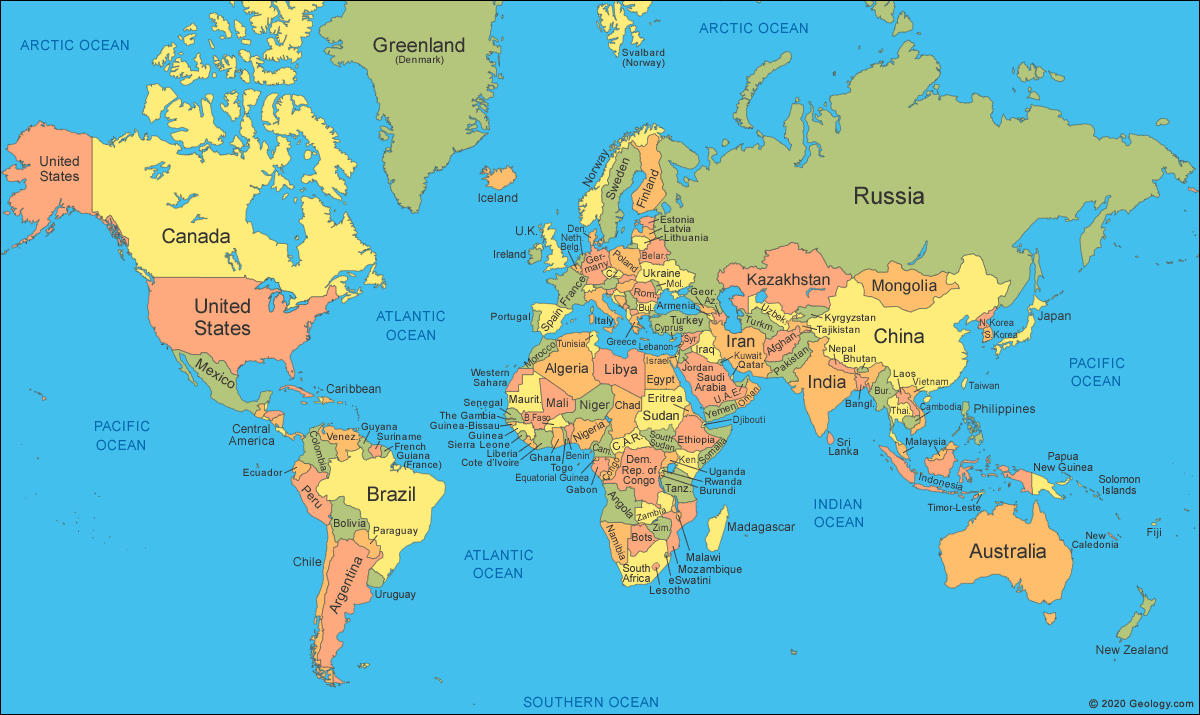
We started out this lecture by looking at a picture of the earth from the moon, and look at the earth in a different perspective. This looks very different, within this year we have talked about China, India, USA, Russia and Europe, where we have looked at the different internal structures.
Interconnections between regions and countries, trade and its importance. Not all is well within each country and the the normality. Internal stresses ned to be monitored, by lots of different groups, areas and companies. Something that we don’t need to consider but keep in mind and know about.


Consequence: Global economic structures are in a state of flux.
This due to many issues that are Political, Cultural, Social and Technological.
It is adapting your designer ability to work with the company. What is it the client is trying to do.
As such things change and alter, new opportunities  arise - as indeed do new threats, this provides moral and ethical issues for each one of gusto grapple with. Your views need to be justified to yourself, in context with the situation…. This is difficult!

So: We now have an understanding of global issues, and how they interplay and the key elements

This global situation is the back drop which you will be involved with when your in a business and whatever the business is.
We then looked at the National Economy
The National economy is affected by the global Economy. This results in the changes with the national economy to be Induced and Directed.

Induced Effects
Here, external changes to the UK cause Internal changes. Such as GM sells the company Vauxhall to PSA (Peugeot). Peugeot closes some UK Vauxhall plants Unemployment in these areas rise. These are often called “externalities” You should keep an awareness of what happens because they’re important and might effect you. An example of this is - One of your main clients faces difficult business conditions, you business with them may be reduced.  On a more daily basis, changes in Exchange Rates can effect trading ability. The movement could cause a few problems if it affects you firm, as the cost could up or it could go down.

Directed effects - These effects are related to internal changes that have a knock effect to the national economy, which means that they are directed to occur.

So-
Taxation changes
Legal changes - including standards
Financial assistance changes, etc.

Some of these changes may be as a result of external forces. Reaction to external changes - tariffs, quotas, etc.
We need to justify ourselves as we need to be more than just designers, we need to make sure that we have knowledge of everything else.
Directed issues can be local and national;
think business rates / council taxes.

To you (as designers) this is probably more important. Such directed changes will affect you. They will also affect your clients.
We found that changes happen all the time.

As designers, you need to recognise that these changes and we have to consider how they impact on us AND on the clients that we work with. This means that this will us to be more understanding of your clients situation. An example of this is payment issues and nothing else.

Market Issues
You and your work in terms of the market you are going to be in, you need to think border.
Competitors are those who do similar work, those who may attract clients money, but are not directly competitors.
They attract money from you.

Markets
Geographical / Location
Market Segment
Customer Type
Design need

Your Business
What you do and end up with, do you have / are developing a specialism in one or more of those areas?
If yes, you MUST keep an eye on the sector performance. We have to be prepared to diversity if need be.
If no, you are a generalist, fine, but ensure you are very good and business like.

Continually assess your market(s)
Just as you review your state (PDP) You also need to review the state of your clients
At the very least we should review with them, with your firm at least once a year. But we also have to consider whether the business activity of the clients has impacted you, for example the market and finances.

Consider membership of relevant trade organisations, there are thousands of them which could help you.

We were told that we should attend trade exhibitions, to look at and see what the market you serve is doing. A few examples of trade shows that we could attend were:

IPEX
Adtech
TfM
Future of Branding
Print and Promotion Live
Sufex

We then looked at the diagram that we were shown in the very first week of the second year at University. We were told that we all need to consider this advice with WHATEVER business we work with.


Friday, 3 February 2017

Outdoor Culture Creativity and Affect - Spencer's Lecture

Within this lecture we started to talk about the subject topic of Outdoor Culture Creativity and Affect. The first part that we looked at within this lecture was a video known as the dream of the 90’s is alive in Portland which is about the Portlandia spirit of the 90's. It started off in the Los Angeles area about a guy who had recently come back from a trip in Portland, where he started to talk to woman about his experiences and how the 90's era still exists which is located in Portland. I found that this video was interesting but slightly weird as well.


We then moved onto to watch the same video, however it was about the same story but the place in Portland had a special place that lived in an era in the 1890's. I found the video very strange and interesting.


Reference - https://www.youtube.com/watch?v=0_HGqPGp9iY

There is a recent (re)turn to concern with nature in Graphic Design. There is a point of historical contact, but there is something that keeps pushing against.We firstly looked at NeuBau First 
(Gandl, 2014) - which is a catalogue where we looked at different layouts of the publication that showed us the different art forms of trees. from photography to Illustrations and Vector Illustrations (graphic). It is intended to be produce to authentic designs, within the catalogue design. Where in which you find the trees are more in the urban areas. High contrast texture photographs such as Bark, simulated surfaces. Trying to show wildlife through digital work. The NeuBau First Catalogue is a collection of detailed silhouettes of trees in urban areas and photography, and separate tree sculptures. 

Within the publication there are four different categories of imagery which are:
- Naturalistic Objective photography
- Vectorised and digitalised imagery
- Urban scenes with naturalistic elements (trees/bushes in pots on pavements)
- Textual details of natural forms (barks, etc.).

Some of the inspiration that was used to address the lack of architectural modelling - attention to naturalistic components and materials which provide architects a better catalogue to work with, by doing this Neubau has made the publication in a downloadable media.

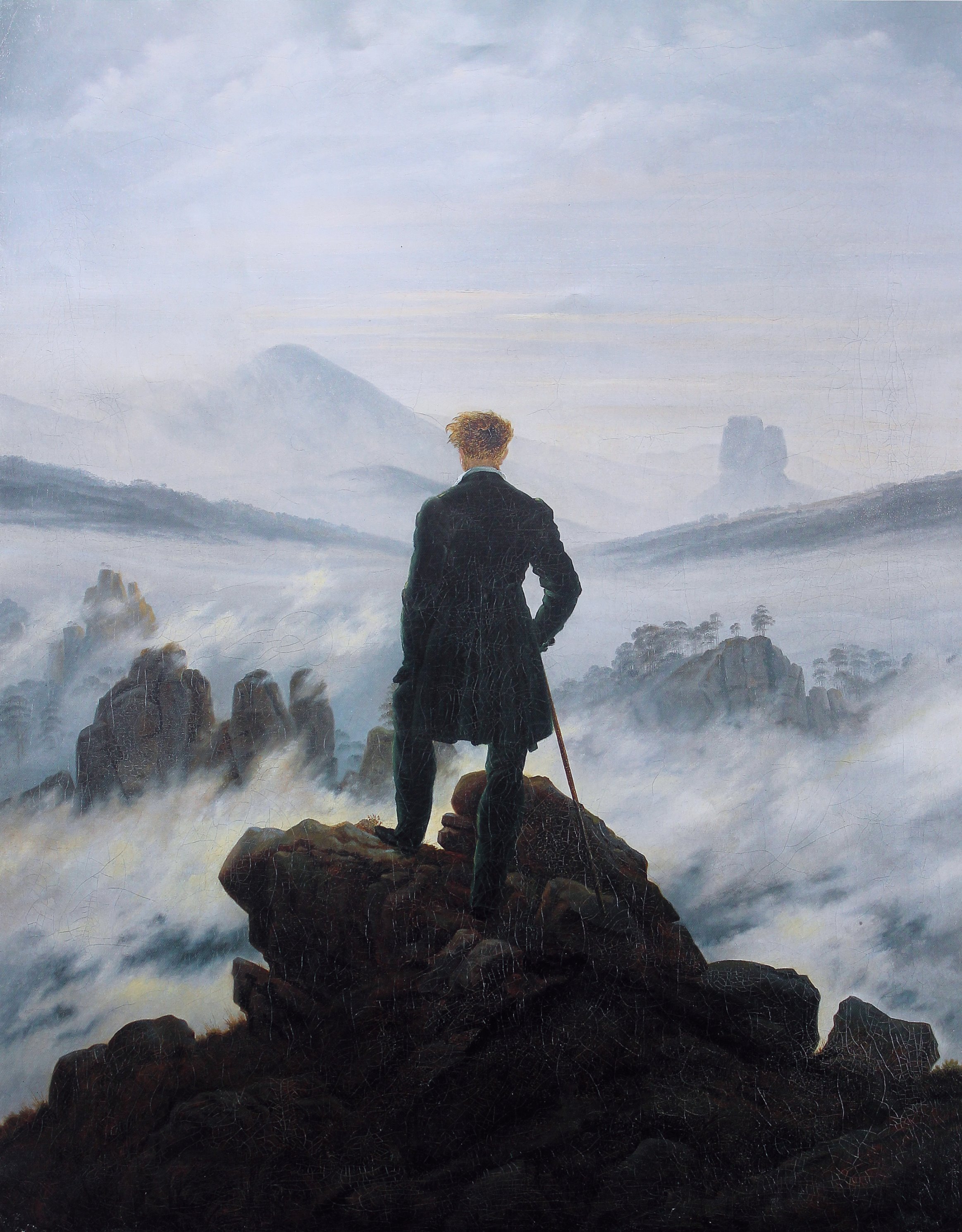
The next one that we looked at was a publication and outcome called the Outsiders by Bowman, Ehmann and Klanten. Where we firstly looked at the front cover of the publication that displayed is someone that is standing on a cliff top that is wrapped in either a blanket or a duvet that has red hair. This makes sense of the publisher’s claim to an: occasional romantic or ironic work, it is a quotation of a image called Wanderer above the Sea of Fog by Caspar David Friedrich, that is displayed and portrays a romantic setting, that has a story behind the painting and image, that is very interesting. We have a connection between this image and the publication which has been intended as a joke. The artificial hair is something that is very intense, and that stands out to the outdoors. We want to see life size version of the outdoors, that is pre-industrial. 

We then moved on to look at what is presented inside the book, which is more about camping technology and about different ranges of camping expeditions. It is all heavy conditioned as there is a guide involved. it is the functionality of camping and camping equipment design, more interesting about travel and people that like to camp. The book has been stylised, I found that this book was quite interesting as I may look into this book even further. 

We then moved onto looked at the publishers blurb and the design focuses of this book:
- Products 
- Brands
- Workshops 
- Organisations


Reference -


How these publications play the tension between the natural and the designed world. we started to look at a pastoral landscape which is a slightly different to romantic concerns. The pastoral is calm and so beauty but has a similar lifestyle, similar types of nature. It includes rural communities, it is a very ordered landscape. Where we were shown an example of a painting that has a rustic world that is about communities coming together and managed vision of nature which was Alvan Ficher in 1854. The outsider book has a new pastoral movement. It is a more conservative form of artwork. We then looked at a review about some of the pictures that we were shown about the ‘Picturesque’ that was fostered by William Gilpin at the end of the 18th century. He urged everyone not just artists to go out into the nature such as the cotswolds and the lake country to look at different scenes that reminded people about the examples of paintings like Claude Lorraine. The interest in the sublime begins to grow out of people’s accounts of the pass. 

We then looked again at the Caspar David Friedrich piece that has a reaction to the neo-classical reason/rationality and has a supernatural account of vision. It is a very expressive, spontaneous and not controlled piece of design work. We some times get photographer that are interested in urban cities and the urban landscapes, like the European countries that the nature is kept in a unkept way. The opposite to east European countries is that they are more romantic and let go. We then looked at arts and craft movement, which was between 1880 to 1914. Where we looked at the artist William Morris and Ruskin where they talked about the quality of life and we then talked about the IKEA advert and chucking out the chintz, IKEA advert in 1990’s. Its all about female liberation. The store IKEA has reformed the british culture and homes over the years. There all natural materials.


I found that this session was very interesting and i'm looking forward to the next lesson to look into this topic even more. Within next session we will briefly look at the language and affect. 

Monday, 23 January 2017

Business Lecture - China + India = Population Issues

The first thing that we were told in this lecture was that more Internships and Placement will start to come onto the internet soon, I was happy to here this because I have recently been struggling to find a placement or internship that I want to apply for. Within this lecture we will be looking at Our World and the border issues, we firstly looked at the world map.


Once we had done this we were then shown a map that presented and displayed the GDP per countries on the world map in land mass proportion and the GDP per capita. I found that this was very fascinating to look at because I was quite interested to see how the GDP looked per each country. However there are emerging markets and problems areas that could be seen as we are the ones that will be dealing with all of these problems and we need to know what the problems are and how they will effect me as a designer and how they will effect me as a whole.


What/Who are these?

Countries and markets that are now developing and have a chance to come to famous. The markets which are growing are becoming the key developer and the potential markets for new businesses. These areas are becoming politically unstable and volatile.

To be more precise

China
India
Russia
Brazil
= Growth/Development Potential.

Middle East
China/Taiwan
Russia
= Problem Regions.

Interconnectivity of Technology

Why is this important?
This is important because they invest in the United Kingdom and some of the clients may well be from these investors and become new economic powerhouses which don't do what you do! There are also many problem areas that are world affecting and the technology will impact on you.

So, we have to appreciate what has happened already in the middle east.

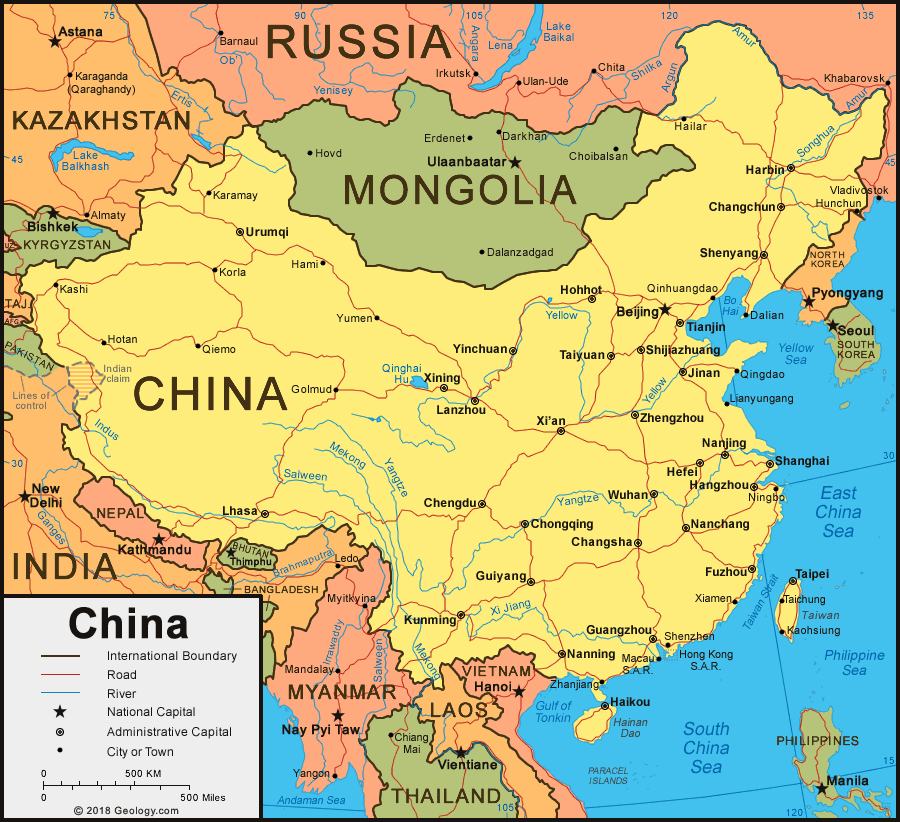
We firstly started to look at China.
Population - 1.4 Billion.
GDP - $9.28 Trillion


We found that communication and travel have more problems to overcome. We then looked at the regions of china and we need to appreciate that how china is unified countries, it isn’t as unified as we thought with the problems that they are facing as a country in relation to Russia.

We then were shown a graph showing Countries GDP levels (World Bank), China is becoming a major competitor. We looked at the graph that features the GDP per capita (USD) the United Kingdom is doing better than China. Provisional Share of GDP Growth in 2014, shows us which of the regions are struggling and that aren’t struggling. We were then show the Energy-Related CO2 emissions. China are increasing and the US are decreasing, which is why Beijing are famous for the smog. We were then told about about how Donald Trump disagrees with some of the methods that China uses.


Key Issues - 

Taiwan:
China regards Taiwan as of China (as it once was)..
Taiwan has a different view. Wants independence after 68 yrs of self rule.
China adamant this will not happen.

South China Sea: 
Chinese navy ( a new phenomenon for China and the world), was been becoming expansionist in the South China Sea, taking over land and islands, buy force if necessary.

Trump (Donald):
Not exactly respecting of China, but with some reason.
China needs to adhere to world business methods.

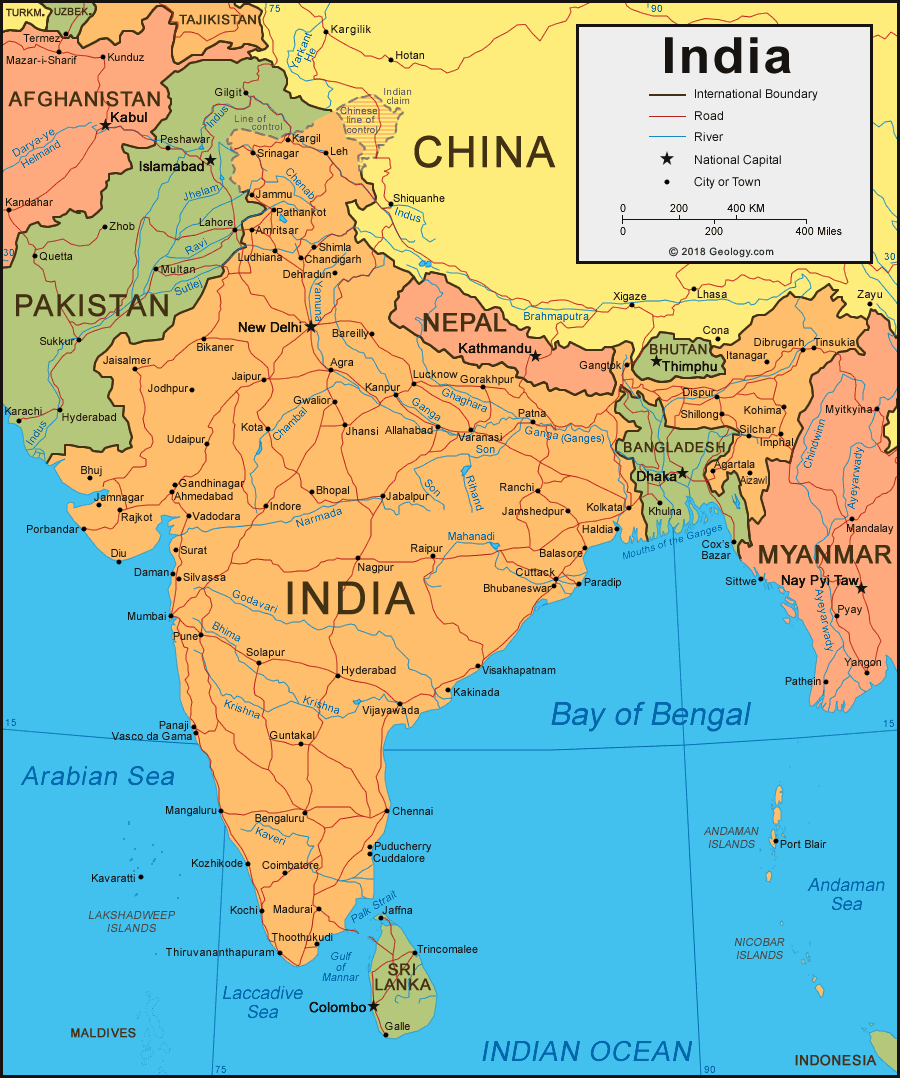
We then moved onto talk about India:
Population - 1.2 Billion
GDP - $5.1 Trillion


It is similar to China but isn’t as bad. There are big cost of shipping between the United kingdom and China, but less between China and India. We were then shown a graph of the GDP in India between the 1950's to 2014.

It has really increased over the years and will keep increasing but will depend on China and there problems, this is whether or not china will close there doors to India and the rest of the world. This means that they could stop trading. We then looked at the GDP Per Capita within India and the CO2 emissions from various countries from the 1990's to 2010.


I found that the country India doesn't have the control like the other countries.
For both countries:

China and India: Have strong development - economically and are doing well, but

Victorian type imbalance of Wealth
Poverty not uncommon, variable across the country
Living standards weak and variable
= Leads to social stress. Problematic for heavily centralised or democratic governments. 
However these difficulties led to serious political disruption in Europe.

There are serious issues of copyright breach.
Needs regulation, which is not forthcoming
…..

There are big cultural differences. The understanding between China and the West is not good as it should be. India are much better with the west and respect each other. So the economic development will be faster, then slow down but they will again get quick but then will slow and will continue to do this.

Many people in the west have what they need which results in high competition and differentiation need is important. Many people in the east don't because they is potential for very high demand.

Population Issues

For the next part of the lecture we then moved onto talk about the Population Issues. Population growth has been very dramatic as there were 7 Billion people world wide in 2015, but only 1.5 Billion worldwide in the year 1880, this shows us the rapid difference. We were then shown the projected world population and the world population forecast an breakdown. I found that this was very interesting to look at because there this could change even more in the up coming years and how this is shown to us differently in each continent.


After this we were then shown the population density, this tend to cause population problems. This creates localised issues. The European Population Density graph is used partly to show why immigration is more within these countries. I thought that this was very detailed and interesting to look at the facts and figures.

We also looked at the graph with the World Demographics which feature age group with both genders female and male in the world in 2014. We then compared this to the graph of demographics in the United Kingdom in 2014, where we found that it was very different. We then were told that this is how we know that the United Kingdom is changing shape.


The final part that we looked at within this lecture was the Thomas Malthus graph and the basic theory. I found that this was also very interesting.

Go past this “Crisis Point” and serious issues occur
War - think food, lifestyle, etc.
…

On the plus side…
You can see the changing dynamics of the population.
This implies the issues a market may face.

I found that this lecture was very interesting and quite factual which I really enjoyed learning about. 

Monday, 16 January 2017

Business Lecture Budgeting and Business Planning

Budgeting

As we have already accounted, budgets are a corner stone that is made up of good accounts.

What is a budget?

An allocation of money (or resource) to undertake a particular task. It may be over a specific task (such as a project) or a time period, or both. Furthermore into this topic budget is meant to be the rea use of resources that supply us with information. Over time, this information is then used to improve companies and future budgets. Budgets also help us to understand HOW and WHERE your costs go and how the money is spent.

Budget
Proposal
Resource
Allocation

Actual
Actual
Resource
Used

Variance
Difference between the Two.
(May be positive, neutral, or negative).

We where then shown an example of the budget actual variance and cumulative variance.

The example shows that the maths and sums to this has already been done so that the answers have already been worked out and easier to see, but it shows that you have overly spent by £12. This is why budgeting is so important so that you can see and work out the problems that feed into one budget. Within the second part of the lecture we then talked about Business and Planning and Media types which I thought would become very useful within the future, when I am a designer working for a company or a company that I have set up and managing yourself. 

We firstly started off by talking about the basics of business planning and what it is meant by this and why it is so important to companies. We were firstly told about the purpose which is the Income, Profit, Charity and Kudos? So what do you want out of this? and why? The next thing we were told was Tye is it Freelance, Ltd, Semi-Partnership and or Partnership. What is the nature of this, what are you actually doing? This MUST be legal and you have to think what you can do, and just something that you want to do. The final basics we looked at was where, where do you want to geographically do business and where would you want this business to be, not New York think smaller such as where would like this company to be located in the United Kingdom. 

This is very important as you need to think these points all through very carefully which will allow these aspects to be successful. If you have no direction, you will slowly drift and will become unsuccessful. The knowledge of where you are will help you out and help you to understand where you would like to go and where you want to be in the future. However try not to start a business until you have thought and mastered these points, so that you will be likely to be unsuccessful. 

After you have done this you can then start to develop several plans so that you can succeed at the task that you have and are trying to do. Plans can go three different way these are: Good, Bad and Ugly, however you do need to address the situation what you have to do. You need to consider the basics which are the cost of living, the facilities that you have and also need to require that includes food and drink the equipment and materials that you need, but also where you are going to live and the cost of travel too and from places. To do this you need to split these two situations into two different groups one being your personal life and the other your business. 

To be certain you need to the financial and resources for both groups in order for you to keep track of your spending and income in an easier and understandable way. For example you need to consider the amount that you earn in order for you have an easy way of living and this will also indicate that when you need to set up your business. However for your Business Life you need look into the cost of running the firm and company, but you also need to consider the way in which is going to run and its from here where you consider the business plan. I found that this lecture was very interesting and was factual and will defiantly help within the future. 


Friday, 9 December 2016

Seminar #9: the Abstract Polina Zioga

This was our final seminar session with Polina, I found this seminar very interesting and useful because I was able to grab some key points from this lecture for when I am writing my own essay abstract. For this seminar we looked at an example abstract that we could highlight and make notes about to answer four questions that I was given to analyse. These were:

What are the main terms and concepts?
The main terms and concepts of the abstract were the keywords that were displayed just below the abstract.

What background information is provided?
The background information that was provided within the abstract to give a brief summary to start off the essay on Visual Hierarchy was "Visual Hierarchy is a significant concept in the field of advertising, a field that is dominated by effective communication, visual recognition and motion".

What do you think is the research question?
The research question is also the title of the abstract and the essay which is "Visual Hierarchy and Mind Motion in Advertising Design".

How do you think the author attempts to answer the question?
The author attempts to answer the question by giving reasons and examples to back up the evidence that they're providing for the question.

For the next lecture I need to find Illustrated text images of stills from movie opening sequences that can be any type of 2D image. When writing our essay we need to make sure that we add images to your essay. We then talked through a structure of an essay and looked at some examples. A question that we were told was what can we write together with a conclusion? What you would further investigate and what you would look into further. This is a good point and what can we gain from this so that we can carry on evolving and developing, we should also consider using sub headings. I thought that this seminar session with Polina was interesting and I am going to keep things into consideration when writing my own essay and abstract.


Monday, 5 December 2016

How To Write A Curriculum Vitae (CV)

Within this Business Lecture we were shown how to write the perfect Curriculum Vitae (CV), in order for us as students to be prepared to apply for jobs and placements that we will want to take or do within our or after our university course. Below is the perfect structure that we follow to create a good CV.

We should firstly start out by writing our:

Name and contact details

- Your Name
- Address
- Telephone (Personal Mobile)
- Email (Uni and Personal)
- Webpage (Portfolio)

Then:

Age - clarifies how old you are
D.O.B - clarifies when you were born
Status - Single, Relationship

After this:

Education - Most recent first
the University of Huddersfield - course
- from/to (give date of expected graduation)
don't put in the grades, grades can tell something about me. this may under sell my self

College - etc

Skills - such as computer literacy (programmes specific?)
Driving Licence

Further more:

work experience - date, organisation and job
couple of sentences explaining this.
most recent to the top

Hobbies and Interests - be brief
Don't put down that you like socialising

Finally:

Referees - work and academic reference
Name
Company
Position
Address
Telephone
Email

After writing out our CV for ourselves we also need to write a cover letter for each job or placement that we apply for, it is important that we always change the cover letter for each job and placement, so that it fits the firm and it is for that firm that you are applying for.

The final part that we looked at within this lecture was I.P, which is known as Intellectual Property. This is like a copyright protected symbol to show that it is your own work. We also talked about:
Intellectual Property Rights
People Own what they create
Idea, Brand, Invention, Design, Written work, Song, Performace etc.
So how do you protect yourself?

I found that this Business Lecture was very interesting because I was able to take a lot on board for when I am creating my own CV and cover letters for the place that I am going to be applying for my Placement Year.

Friday, 2 December 2016

Seminar #8: Information Skills - Laura Williams

Today's seminar was a little different as we had a library session with Laura William instead of having our usual seminar with Polina on a Friday. Within this seminar we started out by talking how we should do when writing our essay and where we can get help or what information and materials we can use to help us produce our essay. The first is to identify all the keywords for the essay topic that we want to explore, this would then allow us to explore all of the areas of our chosen subject to see what we can look into further to find the answers for our essay topic. The next one is that we need to evaluate our information sources, are they reliable or useful. Are they up to date? Is the source trustworthy and can we trust and relate it to our essay topic to back up to our point that we are wanting to make. The next is finding your information for your essay, where could I find this. I could use books, magazines, newspapers or article and internet sources. The final point that we were told was were can we find help, we can find help from tutors and the people that are in the library, so that if were struggling to find something we can find it easily.

We then moved on to how we should generate keywords from our essay's research question. For example by following the process of looking at the research question, then breaking down the question and finding keywords from there. For our task we were told to look at the words in our question and see what words we could come up with from this. My research question was:

"How has the technology in Title Design in Films between the 1960's to Now".

Some of the keywords that I thought of from my research question was:
  • Technology
  • Film Design 
  • Title Design
  • Title Sequences
  • Films
  • Short Films
  • History
  • Old
  • Modern
The next part that we looked at was something that is known as the CRAAP test, which a process that you should use when examining a source that we have found to use for our essay. The CRAAP test stands for:

C- Currency
This is the timeless of the information which means is the information and source you have researched up to date, when was it published? Was it published around the date of the original event because this is very important to consider.  

R- Reliability/Relevance
This is the importance of the information for your needs. We have to consider who published the source? Is the source that you found primary or secondary information? Also does all the information that is provided within article or source all relevant to the essay topic that you are writing. Can we trust the article, as it may contain some false answers and maybe misleading for your essay. 

A- Authority
This is the source of the information. For this we have to consider who the author/publisher is of the source that your looking at? Is the publisher qualified to write about the topic. 

A- Accuracy
This is the reliability, the truthfulness and correctness of the content. Never rely on just one source and the information that is told in the article. Another point to look into is where the information is from and when you look at the information throughly are there any spelling errors.

P- Purpose
This is the reason the information exists. What is the purpose of the information that you decided to look at, is it to inform people about the topic that you have researched. Do the authors make their intentions or the purpose of the information clear. Does the point of view seem impartial or objective?

The final task that we were given for this seminar was to put the process into action, to do this we were given two different sources of information. We were told to find out whether the source of information was useful or not using the process of the CRAAP test. 
I found that this seminar was very useful, as I will be able to se this process when looking into different sources of my own for my essay and topic. 


Monday, 28 November 2016

Business Lecture - Contracts and Finance Sheets

We firstly recapped on the previous lecture that we did we with Peter Norris, which was about Money and Finance. We firstly looked at finance sheets, what we need to start looking at for the future. The first one we looked at considered the costs that we need when doing a project. - so what do we use, we need to ensure it is included in the costs. Travel - to and from the client. The subcontractor. We then were told that we need to look at what is the cost of and working with the exchange rate. You need to make sure that its correct, however it doesn’t pay your salary - we also looked at staff time. The bottom part of the finance sheets is for the clients eyes, but the part above is just for you, which you can develop and improve. Make sure that we look at these costs and on a short basis as it is good to look at and consider.

Company Finances
The cost of electricity, water and other things. For the company not for design work, marketing. How are you going to get people to come to you, you are there. You will have to look after the finances, marketing. You will also have make sure that your design is correct as soon as possible.

Staff Costs
Gross pay - pay without any tax taken off
Pension - that they are putting money into,  its now the law of your employees to get a pension tax, this is known as the Tax level.

Cash Flow
We need to make sure that you know when the money is coming in and when it is coming out. You also need to know when you do this you can pay the back to the bank out - which is known as budgeting. This can also show the bank where you are and what you are doing with the money.

Within the second part of the lecture we then moved on to look at the contracts which we found had two sides too, these were classed as the:

Client Side -  This is the contracts between you and who you are delivering to.
Employee Side - This is the contracts between you and your staff which includes any freelancers.

We then looked into the duty of care and the duty of contract that is included within the Client side. I found that this part was very interesting because at some point in the future this information will become useful to me when I am in a business or have set up my own company. We firstly looked at the duty of contract that included the obvious one which is what the client you are working with has asked you for, the problems that you need to overcome but also consider. So what does the client really ask you for? You also need to ensure that the parameters are put into place. After we had done this we then looked at what is important in the duty of care on the Client side this is the Broader aspect which is to look after the clients that you are working with and their concerns and problems that they have. You also need to know what the clients business is and know the knowledge of what they do and get a broader understanding of the economic environment that you work in.

However you also need to remember a company is a 'Person in Law'.

We then moved on to look at the Duty of Care of the employee side, which again is a very important point to consider when we move into the employment business in the future. This is a lot of employment legislation and the aim of the care of duty is uses to protect employees from very unfair actions and practices. It is used to look after each and every employee including the:

  • Physical and Mental Care
  • Safe Working Environment
  • Clear job understanding
  • Procedures to resolve issues
We then were told about several different terms that related to employment, I found that some of these terms were very interesting to find out what is meant by each terminology that we were shown. 

Employment Terms - 

Resigned - You leave the firm out of your own free will.
Released - The firm that you are working for has no further use for you so they have to release you back onto the job market. 
Dismissed - Not as bad as sacked. This is based on the neutral and depends on the context. 
Probation - Period of time you need to serve before you are permanent and have employment rights. (Notionally, 1 Year)
Redundant - Companies can't hold onto you. The positive part of this is that you gain a statuary pay off.
Sacked - You've been bad, stolen stuff and have been thrown out of the firm/company which is very negative and looks very bad when applying for another job. 

An important point is that you need to know where you stand and the sub contractor, the employee and about the fixed contract, it is important to know what your contracts says. 


Friday, 25 November 2016

Seminar #7: Keywords and Literature - Polina Zioga

I found that this lecture was quite interesting because we told that we should make sure that choosing the correct keywords and Literature within our presentations and Essay's were very important. The first part that we did in this lecture was talk about what we looked at in the previous lecture. Where we looked at the Essay, the brief, the essay structure and the visual appendix that we need to produce by February 2017. The first thing that we were told to do, was to try and pick out the keywords within our title's from our presentation that we had created and the topic that we were going to talk about. My title for my presentation was 'Title Sequences between the 1960's and Now'. I thought that the most important keywords and Numbers within this were 'Title Sequences' and '1960's and Now'. We were told that we should try to look at how author's may use other words to present what the are saying, for examples Openings, Opening Sequences.

We then moved on and talked a literature review. A literature review is a critical presentation and discussion of the main topic you are looking into.

What does a Literature Review do?
A literature review is used to tell the reader that you have got an idea about what you have read into. Even looking at online sources, it tells the reader you have a good indication of what is going on. A literature review is how to find the main works, of the subject that you are looking into. This means that the work you have produced has a important effect on the succeeding development on the subject. We were told that it is very important to make sure that we reference everything even on the date that we used it and we should not also use the internet but using books may help us even more. It also shows them the knowledge and understanding that you have established. The varieties of the approach that you have taken to get to your final outcome.

A Literature Review Structure

  1. The first thing we should do is tell them the outline of the topic you have looked at.
  2. The next is to give a brief explanation of the history and give several definitions of this.  
  3. After we have done this you can then start to work on the main body text, which is the main ideas, writings and practice you have researched into. 
  4. The final part to do is to present our research question and find out what you need to do to push this further, to find the answer.
It is very important that we make notes, to everything that you read because this will help you in the future and back up the point that you are to make. It helps the reader to show us your understanding of the topic and subject field. Another point is to keep a copy of the resource, whether this is a scan to keep a note of the resources you have looked at. Make sure that you reference the websites, books, articles that you use. There is also three different types of literature, these are: Primary, Secondary and Tertiary. We found that we need to make sure we have more primary, less secondary and even less tertiary within our work. 

I found that this seminar was quite useful, as I found that keywords and literature reviews are very important when creating an essay and presentation. I going to keep this in mind, when writing my presentation and essay. 

Friday, 18 November 2016

Spencer - Animated Documentary, Barefoot Gen

Barefoot Gen


Within this lecture we were shown an animation, which was directed by Mori Masakis in 1983 called Barefoot Gen. It is an anime film and was the first ever translated into English, the poster example that we were shown for this was like a comic strip, this was created by Keija Nakazawa. The anime film was based on the events that happen in Japan on the 6th August 1945, which was based around the time of the bombing of pearl harbour. However it was the story that was based towards the bombing that happened in Japan around the time. It is a Japanese artist and/or author that is looking into these events. Within this lecture we watched the first 30 minutes of the animated documentary.

Within this animated documentary there is lots of symbolism within the film to create a strong crop. All of the arguments with the people in this film is to do with the food shortages, it's like a metaphor to show the symbolism of food shortages in the town that the anime film was set. The animation is about the lives of the people that were living in Japan when the war was taking place between Japan and the USA and the attack on Pearl Harbour in Hawaii. A plane known as a B-29 is seen undetected and bombs part of this town that is being shown in the anime.

In my opinion I am not sure about this Film and Animated Documentary, as the storyline of the animation was very sad, as the little boy saw his father, little brother and older sister die due to the bomb attack on the town. I had a lot of mix feelings about this animation.

We then moved on to look at David Deamer who is the author of the book known as Deleuze, Japanese Cinema and the Atomic Bomb. He wrote this book as an analysis of the animation that we had just watched, which he compares with the Lucky Dragon in 1959.

Going back to the Animated Documentary there was no dialogue at all throughout the explosion to give a effects that creates a big impact to the film when this event is taking place. We get to see the expression of the emotion throughout the event. Another point that I want to make about this animation is that there are lots of metaphors and symbolisms.

The final part that we looked at within this lecture was someone called Thomas Lamerre, who focused on the comic strip between Barefoot Gen. Both the Structural Line and the Plastic Line and how they vary over the course of the Animation film and Documentary.

Seminar #6: Essay + Visual Appendix

Within this seminar we were given the brief for the essay, which we were told was already on unilearn in the theory as practice section. It tells us what we need to do and the deadlines that we need to meet for this part of the course for second year. The essay is 2500 words, which doesn't include our references, the essay that we will have to do is based off the presentation title or research question that you have just been presenting. We were then then shown two different examples of essay's that showed us how the structure of our essay should look like. This allowed us to look at the layout that we need to follow when creating and writing our essay. To start off the essay you need to start with the title, mine was 'Title Sequences between the 1960's and Now?'.

The structure
  • Introduction - Title 
  • Abstracts and Keywords
  • Introduction to the essay 
  • Main Body 
  • Conclusion 
  • References List and Bibliography
Feedback is very important on the essay, we need to make sure that we produce a 750 word draft of our essay for our formative assessment by February. We also need to produce along our essay a Visual Appendix (Poster) or a visual summary of our essay. Where will use our 150 word abstract to help us to produce another 2500 words. The size of this Visual Appendix needs to be A2 Size. 

What is an Essay?

An essay is an argument, where the essay is a concise evidence. 

We were told that we need to make sure that the essay has a clear defined structure, a clear narrative and be well written. The references aren't included in the essay's word count, we were advised that we should create a folder to become organised and not get mixed up with the different materials that we have been provided with. We then looked at the Do's and Don't of what to do when writing an essay, I found that this was quite useful because it is something that I could follow and look at when writing my essay to make sure that I do it correctly and not incorrectly. 

Do's 
  • Define terms.
  • Write carefully. Build good sentences. Link related sentences in clear paragraphs. Work toward an overall structure.
  • Use time flow.
  • Provide sources. Offer evidence.
  • Present and discuss contrary evidence.
  • Cite direct and paraphrase quotations carefully and explicitly.
  • Read aloud. Revise and rewrite.
  • Find the environment, time and routine that works best for your writing.
Dont's
  • Use slang and jargon.
  • Use professional, technical or 
  • scientific terms that you cannot 
  • explain or define.
  • Use fancy words.
The most important thing to make sure is that there are no Grammatical and Syntax Errors, within your essay as this may create some difficult within the written work. The difference between Grammatical and Syntax Errors is that Grammatical is spelling and the Syntax Errors are tenses and the way that the sentences read. For our next seminar we need to look at the feedback that we will receive next Monday from our assessments and change the improvements within our presentations using the feedback. I found that the seminar was quite useful. 

Monday, 14 November 2016

Business Lecture No.6 - Entrepreneurship

The first thing that we talked about in this business lecture was a Campaign and Marketing Week. This is where advertising campaigns that are from companies are sent before they’re released and the marketing week is in relation to brands, campaigns and advertisements. In todays lecture we started out by looking into firms. However; we firstly recapped on what we talked about in the previous lecture, which was Business Finance.

So what are firms?
Firms are individuals traded goods.
In effect to this, most people became sole traders - self employed individuals.
In many cases, this is still a form of trading today.
This can be in physical product, or services.
Its easy to start and very common with designers, more of freelance people.
However there is a warning, if you start up a firm, but ENSURE you keep a very clear record of your trading. To do this you should keep track of orders, purchases and other types of business to keep as a recored. This is because the tax man will want to know, so keep a good clear financial background wherever you end up. Individuals traded goods in the 1750’s have grown over time and individuals needed more money to develop trade that has resulted in Partnership.

What is a Partnership?
A partnership is where 2 or more people get together with the intent of supplying good or service for financial return.
It is easy to start, as you can agree with something and be away. Although it is a little more difficult to stop, as a formal dissolution is needed. However, if there is no partnership agreement made the finances are split equally between the partners. When your in a partnership you are joined and liable for each others debt. This implies TRUST in your fellow partners that you are in business with. Sometimes partnership have one partner that has the responsibility of the money and the other is more of the trade and ability. But modern partnerships are more complex and Limited Partnerships provides a limit on debt. However, whilst partnerships are still used, it became evident that more funding was need for the growth of the trade throughout the Victorian time.
For the second part of the lecture we focus on Entrepreneurship and Business Engagement. You have to follow a certain process which is:


So what is the aim? 
- is it the money
- kudos?
- society/aid?
and how do you succeed?

1. we have to strike whilst the iron is hot.
- Go for it, just do it, make it work. This implies the DESIRE to make it happen, we were told that we shouldn't sit back and wait for it to come to us, we need to go out there.
2. Tenacity.
- There will be problems, but we shouldn't give up. Work through the issues and solve the problems that we have to overcome. This implies the DRIVE to make this happen.
3. Don’t be precious.
- Its your idea, but it will change. Its your Work, but it will be modified. We have to have the courage and the grace to accept alteration and change the design or the work that we have produced. This implies the ability to LISTEN to others.
4. Ability to Do
- Practical/Pragmatic and the ability to Act. This implies the ability to ACT or initiate ACTION.
5. Its not WHAT you know, it’s WHO you know.
- Not Ideal. Get over it. No one said Life is Fair. Understand it, use it. Who do you know, who should you know? consider Linkedin, Trade Associations, Up coming Individuals, Business Leader and Key supporters that support the business.
6. What is the cost and what is the return
- If someone is going to help you. There will be a cost. Know what this is. So how can you achieve this?

Need to create a linkedin.

I found that this lecture was very interesting helpful to me when I am in the design business and world. I am going to keep this in mind in the future.

Friday, 11 November 2016

Emigre and 8v0: The Legibility Wars - Spencer's Lecture

Within Spencer's lecture we firstly recapped on the previous lectures which was about the brief histories of Animation and graphic Design. Also the claims of expanded practice in Animation and Graphic Design. The point of this lecture is partly to try and address the big debate in Graphic Design around legibility and in communication about how things are clear, but there is also a post-modern thing that pushes against this and questions the idea that the communication for it to communicate it has to have a strong legibility. Its about the power of Graphic Materials itself.

One of the publications that foregrounds this is the Emigre Magazine that ran from 1984 to 2004 and foregrounded this issue with communication and legibility, modernism and postmodernism that was done in a provoking format. It had a massive influence, both stylistics within Graphic Design because it also meant design criticism and design theory that designed a visual war. Lots of arguments about legibility and communication came through the Emigre magazine.

Also within this lecture we will also be looking at another publication in comparison to this called 8VO or the Octavo, these had similar concerns but from more apposing in the debate. Emigre was one of the first publications to arise out of the purely digital publication techniques. It was one of the first digital Graphic Design publications. It existed through different types of formats from Large Prints to small hand paperbacks and Music CD's that changed a lot over the course of the publication to keep this up to date.

The Emigre was a collaborative project that was founded by a Dutch, Editor and Designer known as Rudy Vanderlans and Zuzana Licko who is a Czech founder and Typeface Designer. Emigre was also one of the first type foundries that also started to digitally distribute there resources, as they did this lots of other publications started to look very similar to the Emigre. this then had a massive influence and became the face of publishing generally. It was originally published in San Francisco in the USA. The founders original idea was to publish and focus on in between-ness, it was used to showcase work of the Emigre's that are the writers, the designers, artists who live, or had lived outside of their country of origin. Lots of qualities came out of in between-ness:

  • Technologically Engaged
  • Critically Engaged 
  • Transformative Graphic Language
  • Exploratory and evolving visual language 
  • Hard to pin-down style
They were also the first people to use the Apple Macintosh, they exploited the quirks and possibilities of the software to produce new annotative design language. We then moved onto look at critics that have spoken about the Emigre magazine. The first one we looked at was Massimo Vignelli who was Neo Modernist designer that talked about Emigre as an abberation of culture and an national clamity. also Stephan Heller who is an middle ground - design journalist said that the Emigre is like a blip in the continuum and the cult of ugly, like its an anti art, trash ethics starts to appear around this publication. The final critic we looked at was David Carson who is a post modernist designer who is a commercially successful designer, he initially champions there work, but then starts to condemn it because there distributing there fonts so it starts to saturate culture within that period of time. His phrase is "Don't confuse legibility and communication" this means don't equate them with the same thing.

We then started to look at the Allies of the Emigre such as Stephan McCarthy who is an Author and Writer. He says that despite digital context it can be mapped into the tradition of William Morris. we then looked at Gill Sans who named his typefaces after people that were very close to him, as he was influenced by personal qualities. The voice of a new generation of Graphic Designer; postmodern, deconstructed and experimental.

In 1988 Vaughan Oliver (4AD) issues devoted to album covers that was very similar to the likes of Tim Burton that was very poetic. Oliver started with a part of the Human (Human Body)/ Human Cultural Artifacts that had a poetic surrealist style. We were shown some examples of the emigre magazine spread, from this I found that there were lots of different combinations that were very board and disrupted. Once we had been shown this we then looked at the Cranbrook design and the Cranbrook Academy of Art that was a collaboration with Jeffery Keedy, Lorraine Wild, Ed Fella, Andrew Blauvelt and Katherine McCoy. Jeffery Keedy, Lorraine Wild and Ed Fella were all linked to the Cal Arts that also became part of the fold. The Cranbrook's design became famous  and notrious for it's style and approach.
We also looked at some of the work which was shown in the Walker Art Gallery which was rebrand for exhibition design. These were 'Snap On' Serifs, Vertical striping patterns and morphs and Combination instructions for designers. The content that came from the Cranbrook's design was:
  • Interviews
  • Profiles 
  • Reprints 
  • Lengthy Essays packaging in design
  • Letters to the Editor (Dear Emigre).
The last part that we did was talk about Octavo and how there was a link between them and Emigre which has a more modernist lead, where there is a more experimental modernist approach that has some Swiss punk that flowed through both Emigre and Octavo. The designs layout of Octavo were resolved as full-scale mock-ups using dummy typesetting, acetate, paint and so on - trying to get as close as possible to appearance of the final printed work. 

I found that this lecture was very interesting as I feel that I learnt quite a lot from the lecture that I didn't know about. 

Seminar #5: Assessment Feedback - Polina Zioga

In today's seminar we were talked about the subject of our assessment feedback, from our presentations that we had presented the week before in our assessment week, which I found quite scary as when I present something to people I tend to become quite nervous. However; over the course of this year I do hope that this improves and I do become more confident about my work and when presenting in front of people. The first part that Polina told us to do in this session was right down what we thought went well in our assessment/presentation? What we could improve? and What I need to consider after receiving my feedback from my presentation? I found that two of the question were quite easy to answer but the other was a little more difficult, however here are the responses that I developed when looking and thinking about the questions were.

What did I do well?

I found that something I did well was to keep my presentation relevant to the subject I had chosen and also to stay focused on the presentation and topic that I was giving.

What I could improve?

How I presented my presentation because I was nervous and could have spoke clearer than what I could have done.

What I need to do from my feedback?

The part that I need to look at and develop further for this presentation is to look deeper into my chosen subject.

Once we had done this we looked at the good and bad points about the presentations overall that we had presented to the tutors. I found that there were less positives than negatives, however I don't think that this means that there is always improvement that is needed somewhere when creating our presentations.

Good Points

  • Presentation Design - It fitted the guidelines of the assessment criteria
  • Topic/Subject - They were very interesting
  • Aural Description - Good Time Management of the presentation that was being presented.
Bad Points
  • Presentation Design - Overall the text and images were quite close to the edges of the powerpoint and presentation. It should be more visually engaging and less text and better use of words, but not too fancy. 
  • Topic/Subject - Some subjects or topics are quite broad and need to be narrowed down. 
  • Title - The title should not replicate and be the same as your research question, it needs to summarise the whole topic or subject that you are researching into. 
  • Research Question - The research question needs to be phrased and said as a question. It should also be focused on the topic that you are researching. 
  • Aural Description - We need to practise talking about our presentations. 
  • Language - Use the correct terminology and Grammar, Syntax Errors. We also need to avoid using slang words. 
  • Referencing/Bibliography - Make sure you put this at the end and follow the APA 6th Referencing System.
  • Finally Submission and Attendance - You need to make sure that the submission is on time and improve our attendance because this will allow us to improve our performances.
Time Management

This is very important, time management is needed for the preparation that you need when doing your presentation. When you create something early it will make it a lot easier to spot a mistake, well before you need to submit your assessment. Also another important part is feedback that you are given because it will help you to improve the presentation that you are going to be creating. We need to make sure that we make notes every time we are given some feedback, as this will help you in the future. In next weeks seminar with Polina will be given the essay brief. I found that this seminar was quite useful, as it allowed me to think about what I could use to improve my presentation to make better.


Monday, 7 November 2016

Business Lecture Number 5 - Economics and Finance Basics

The first thing that we looked at and were told about in this lecture was a website Graphiccompetitions.com, this website is a site which allows you to look at active design competitions that you could take part in. This could be our spare time, which would allow us to expand and develop on our skills that we already know or want to learn and improve. We then previously talked about the subject that we looked at in the lecture before this one, I found that this was a good point because allowed me to recap on what we did in the lecture.

To start of with in this lecture we focus on the Economic side of Business, where we looked at several graphs that showed us how the Sales, Quantity, Demand, Prices and others all work together. When looking at all the graphs I noticed that they were all very different to each other. The one graph that we looked at closely was the Inelastic Demand and High Elastic Demand graphs because when we placed them together you could tell that they were completely opposite.


After looking at the graphs we then started to focus on the Government and how they try to manage their economics. I found this very interesting because I hadn't learnt about it before and was interested to find out and see how it worked. We then moved on to talk about the different Taxes and what taxes are? Taxes is the method that is used to raise money for the government and it is the idea that is used to be spent to benefit all. Below is the different types of taxes:

Different UK Taxes

Income Tax
National Insurance
VAT (Value Added Tax)
CGT (Capital Gains Tax)
IHT (Inheritance Tax)
Corporation Tax
Vehicle Excise Duty (Car Tax)

Duties

Stamp Duty
Import / Export duty
Hydrocarbon Duty / Tax (Fuel Duty)
Alcohol Duty (Beer Tax)
Tobacco Duty

There are lots of things in the world that we spend on that include the NHS, the Police, Armed Forces and education.

We then moved on to look at the subject of finances itself and what it is?

What is Finances?
It is all about the control of money, also the flows of money. So where does our money go and how does it flow. We do this everyday, as we keep an eye on our money, but some are better than it than others. Although; business is no different, however a long time ago people made things, and traded them with each other to get other things that they wanted this was mostly commonly known as a Barter which is like an exchanger. The trade that was mostly made within this was about food, an example of this is the Shekel which was a set weight of barley. Furthermore into this the trade after a while used standard values and common values, which was like set weights or gold and the silver. This was then developed overtime which was better for local trading, as they began using tokens, it was the start of the many early monetary systems that began around the 700 BC, this became more important as regional powers grew. However shortly after this minted coins became more common because of the growing economies and the complexity of the economies, this was then the start of the money that is used today. 

What is money?
It is a medium for smoothing trade in all things, its a measurement method of value. However arguably it has no intrinsic value.  However; money has several different definitions because it is the cash that you have, the cash you have and the cash that you can get. For example from your savings. it is also the cash that you have, the cash you can get and the loan credit. The loan credit could either be short term or a long term loan.

When then moved on to talk about the cost and the price of items. The cost is what you have to give to make sure that the product is as it is described and also to make sure that the product is valued at the correct value. The price is what the item will be sold for. After this we then looked at Profit, which the difference between the cost and price that is positive because it determines how much money you will make when the product or item has been sold. Loss is the negative difference between the cost and price this shows us whether or not the item work or doesn't because if there is a loss there is a chance that the product could be taken off the market.

A few definition of other terms that we looked at and need to consider when in the design business or going into a business of our own.

Income
This is the money that you receive and comes in which could come in many ways like credit or cash.

Expenditure
This is known as the money that is usually used when it goes out of the bank, like spending.

Debt
This is how much money that you or the company OWES. It is also known as the negative part.

Credit
This is how much money beyond that which you have, you may use. It is also known as the positive part.

We have to deal with this everyday, companies are no different. The task that we were then given was to try and work out how much we spend each week and how much we spend each year? I worked out that I spend a lot and I need to try and cut down on the amount that I spend.


Friday, 21 October 2016

Claiming Expanded Practice (2): Animation

Following on from the previous lecture of Claiming Expanded Practice in design, Spencer this week covered the animation side which I was really interested to find out about, as I am doing both Graphic Design and Animation I thought that this maybe an interesting topic to look at. We firstly started out by talking and recapping on the previous lecture with the author, writer called Alice Twemlow. Within this session we looked at a handful of different animations that explored the way in which contemporary animation is shown through expanded practice.

We started out by looking at a conference that had been organised by Suzanne Buchan that was themed around the idea of the animated kind implicating everything. Where invited speakers from all around the world, people who landmark thinkers and practitioners within animation expanded territory. We then talked about one of the speeches by Johnny Hardstaff that was about the use of CGI in advertising, who runs a cgi based design company that deal with lucrative design contracts, but he has a double edged take on what he is actually doing which become quite interesting. Looking into his speech even further will looked at several different types of campaigns that he is involved with that are:

  • Sony Orange 
  • 'In the mouth of advertising' - fascinating
  • Global carousel of meetings - pattern of meetings
The first video that we were shown in this lecture was called Honda the COG. I found that it looked real, but it was created using CGI, the seams are so close together that you can't see them which makes the film very effective. I think that the advertisement is well put together and was surprising that the company like Honda used CGI, but they used it professionally and perfectly to make sure that the advertisement stood out.


We then moved on to look at Sony Bravia advert which also made using CGI. People once again thought that the releasing of thousands of balls down a street was a real life event, so Sony took advantage of their advertising and said that this was a real life event but in fact it wasn't a it was made using CGI.  


I found that this lecture was very interesting and I feel that I am going to look into this topic even further. 

Seminar #4: Assessment Preparation - Polina Zioga

The first thing that we did was look at the assessment preparation checklist that we need to use to see about our presentation that we have to produce about my chosen subject. We also looked at Design + Content + Delivery, and recapped on the previous lecture that we had done with Polina and talked about we were should be with our presentation. Polina then talked about what we should include in our presentation, which is to have:
  • 1 Slide with your Title, URL, Name / Surname and Course
  • 2-7 Slides which will depend on your visual communication design, this will include the Background and relevant examples either text or/and images, however you need to avoid videos as these take too long to present. 
  • 1 Slide for my main Research Question
  • 1 Slide for my References and Bibliography
The most important fact that we need to consider for this presentation is to REHEARSE, because you need to know what you talking about and presenting in your assessment. Something else that is important is make notes about what you would like to say in your presentation, as this may help you throughout the assessment, but an important is to not read from your notes so rehearsing is very important. 

Since the previous lecture I have been working on my presentation by researching into my chosen subject, which is Title Sequence Designs between the 1960's to Now and how they have changed? For the past week I have been looking at Title Designs that have been produced in the 60's by the designer known as Saul Bass and title sequence that have been created in the present day by the company called Elastic. I also had to research into the background behind Title Designs and how they established, I found out that they started off in the early 1900's. 

I found that this seminar helped me because it allowed me to speak to Polina and receive feedback on how I could improve my presentation. To receive my feedback I sat with and talked through my rough draft of the presentation that I had produced. The feed back which I received was very helpful because she told me that I had quite a bit of writing and I need to summarise and be brief on the background of the title design, as I had a lot information on this which she thought was too much. She also said that I should pick example of 1 design from each era, which is 60's and now, because she thought that I wouldn't have a lot of time to present all of the examples that I had picked. The examples that I have chosen to work with is Saul Bass's The fact of Life and the new James Bond film Spectre.

Furthermore into this I have thought about what I am going to research for each of my pages and work with this plan to research into my chosen subject this will be:

  • Slide 1 - Title, URL, Name / Surname and Course
  • Slide 2 - Brief Summary of the Background and Literature review of Title Design
  • Slide 3 - Research into the Saul Bass (Title Designer from the Past)
  • Slide 4 - An example of his work (A Fact Of Life)
  • Slide 5 - Research into a Title Designer or Company in the Now
  • Slide 6 - An example of their work (James Bond Spectre)
  • Slide 7 - A Timeline of how technology has changed throughout Film and Title designs
  • Slide 8 - My Main Research Question
  • Slide 9 - References and the Bibliography
I am also going think about any additional pages that I could add to my presentation.